
You've decided to open a luggage-storage business. Good — the demand curve is the right shape, the unit economics work in tourist cities, and the operational complexity is manageable. The next question is the one that decides everything: do you franchise, or do you go independent on your own brand?
We talk to operators making this call every week. There's no single right answer, but there are clearly wrong choices for specific situations. This is the framework we use to think through it — and the maths underneath.
The two models in 2026
The franchise model. You sign up to operate under a marketplace brand (Radical Storage, Bounce, BagBnB and a handful of regional alternatives). They send you traveller bookings; you provide the storage; the marketplace takes a cut and owns the customer relationship. Capex on your side is low because you can usually run with manual handling and basic shelving. The upside ceiling is also low, because every booking is mediated by — and branded as — someone else.
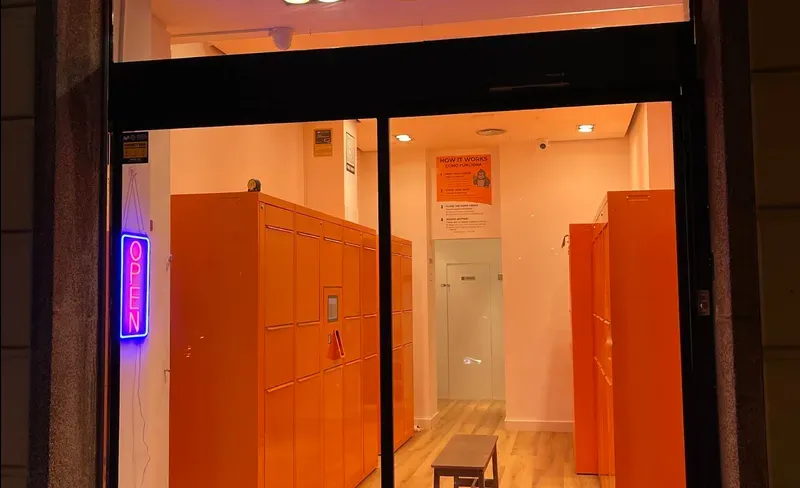
The independent model. You build your own brand, your own customer-facing website, your own pricing rules, and you accept bookings directly. You run on a software platform (LockMe and a couple of others) that gives you the storefront, the booking flow, the payment orchestration and the operational dashboard. You own your reviews, your Google Business Profile and the right to retarget customers. Capex is higher (you'll typically buy smart lockers), but every euro of margin you generate is yours.
The choice is rarely about "which is cheaper at month one" — it's about whose customer is this, and who captures the value over five years?
Setup investment
A franchise lets you start with shelving, a clipboard and a Stripe account. Two thousand euros and a week of paperwork and you're operational. The platform fee on each booking absorbs the rest of the technology cost.
An independent operator typically commits more upfront:
- Smart lockers: €4,000–€18,000 depending on size and count.
- Storefront fit-out: variable; most independent shops spend less than €2,000 if they keep it minimal.
- Software subscription: typically €49–€299/month plus a small per-booking fee.
- Branding and design: usually a one-off €0–€2,000, depending on whether you do it yourself.
The honest number is that an independent luggage-storage shop with 30–60 lockers costs between €8,000 and €25,000 to open. A franchise location can cost less than €3,000. Whether the extra capex is worth it depends entirely on what you build with it.
Ongoing fees and unit economics
Here is where the conversation gets interesting. A franchise typically takes 30–50% of revenue, with the marketplace setting the price. The operator's share of a €5 booking is somewhere between €2.50 and €3.50. On 800 bookings a month that's around €2,000–€2,800 of operator revenue.
An independent operator sets their own price. The same €5 booking in Barcelona becomes a €6 booking in Madrid central. The software costs are an order of magnitude smaller: 5% revenue share or €0.55 per booking on a typical SaaS plan. On 800 bookings a month, software costs hover around €40–€240, leaving the rest with the operator. That's €3,800–€4,200 of operator revenue for the same volume — at lower marginal cost.
The cross-over point is around 200 bookings a month. Below that, franchise economics may look fine. Above it, every additional booking pays significantly more on the independent model, and the gap widens fast.
Pricing freedom
Franchises sell their reach by enforcing a consistent customer experience across all locations. That includes the price. You don't get to charge differently for a Friday afternoon at the finish line of the Barcelona marathon than you do for a Tuesday in February. You don't get to bundle multi-day storage for hostel guests. You don't get to offer family discounts to drive repeat visits.
Independent operators do all of those things because the system supports it. Time-of-day pricing, surge rules, multi-day discounts, group bundles, peak-week markups — none of it is exotic; it's a five-minute config change in a modern luggage-storage platform. The result is a margin lift of 15–35% over a flat-rate franchise model, in our customers' books.
Where the customers come from
The franchise pitch is that demand is solved. The marketplace runs paid acquisition, has SEO presence in the cities they serve, and routes travellers to your door. You give up the customer relationship, but you don't have to think about acquisition.
That pitch is more honest than the alternative pitches you'll hear. Marketplaces really do drive volume in the early months. The question is what you have after twelve.
Independent operators acquire customers through a mix:
- Local SEO — a real storefront page that ranks for "luggage storage [city]" and the long-tail variations
- Google Business Profile — the single highest-converting acquisition channel for storefront businesses
- Hotel and hostel partnerships — most reception desks will recommend a nearby trusted operator if you ask
- Review-driven repeat / referral — the most underrated channel, available only if you control the review surface
- Paid search if you want to scale faster
This takes longer than just turning on a marketplace tap, but each channel compounds. By month twelve, an independent operator typically has a Google Business listing with 4.8★ from 200+ reviews; the franchise operator has zero reviews on their own listing because all reviews went to the marketplace.
That asymmetry shows up everywhere downstream. Repeat customers are 7–12× cheaper to acquire than new ones. They don't exist for the franchise operator — they belong to the marketplace.
Operational support
Both models offer some form of help when things break. The shape is different.
A franchise typically gives you a centralised support team that handles customer complaints, refunds and disputes for you. That's genuinely valuable when you're starting out and don't yet know the patterns. The trade-off: you can't deviate from the script. A regular who wants to leave their bag overnight at no charge in exchange for a five-star review — the franchise won't approve it; you can't override it.
Independent operators handle their own customer ops, with a few force-multipliers. WhatsApp AI booking concierges (which LockMe and a handful of competitors offer) absorb 80–90% of inbound customer messages with no human in the loop, in any language the customer speaks. Self-healing payment retries, sensor-based locker recovery and rule-based refunds remove most of the routine work. What's left — the genuinely interesting customer moments — you handle yourself, the way you want to.
Exit and territory
This is the one most operators don't consider until they need to.
If you franchise and decide to leave, you keep what? The shelving and any unbranded hardware. The customer database is the marketplace's. The reviews are the marketplace's. The website you sent customers to is the marketplace's. You start over from zero somewhere else.
If you run independent and decide to leave — sell the business, change cities, retire — you have an asset. The brand has a Google Business Profile with reviews, a customer database, a website with traffic, partnerships with local hotels. A small but real number of independent luggage-storage operators sell their businesses each year; nobody sells a marketplace franchise location for anything beyond the hardware.
Territory protection is the other side of this. Franchises usually offer territory exclusivity — no other franchisee in your area. That's worth something. Independent operators have no exclusivity; another operator can open across the street. The flip side is that no one can copy your brand, your reviews or your customer relationships, and those are the moats that matter.
When the franchise model still wins
We're not pretending franchise is wrong for everyone. There are real situations where it's the right call:
- You want a side income, not a business. If you're operating a small luggage-storage corner in your existing shop (newsagent, café, mailbox-and-print shop), and storage is a 10% revenue line, the franchise mediated bookings are easy money. Don't bother with all this.
- You're testing a city before committing. A franchise lets you sense demand for six months without buying lockers. If volume holds, switch to independent then.
- You're risk-averse and value certainty over upside. This is a legitimate preference. Lower ceiling, lower variance.
When the independent model wins
The independent model dominates when:
- You're treating this as a real business and you want a brand at the end of it
- You expect more than 200 bookings a month per location
- You want to expand to multiple stores
- You care about owning customer data, reviews and acquisition
- You want pricing freedom for events, peaks or partner stays
- You're willing to invest €8–25k upfront to compound for 3–5 years
That's most of the operators we talk to. It's also why the LockMe customer base skews toward people who chose independence after running a franchise location for six to twelve months. They came to us with the marketplace experience already, and built the brand they wished they'd built on day one.
Quick decision check
If you can't answer "yes" to at least three of these, the franchise model is probably right for you:
- Do you expect 200+ bookings a month within 12 months?
- Do you want to own your customer relationship and reviews?
- Are you willing to spend €8–25k upfront on hardware and setup?
- Do you want to set your own prices and rules?
- Do you want a business you could eventually sell?
If you said yes to four or five of those, the independent model is the right one. The next question is which software platform to run on — and that's the topic of our buyer's guide.
If you want to see what the numbers actually look like before talking to anyone, run them in our profit calculator. Six inputs — locker count, daily ticket, fixed costs, occupancy, growth, ceiling — produce five years of side-by-side projections for LockMe vs. franchise, with a downloadable monthly table.
If you'd like to see what an independent luggage-storage operation looks like on LockMe before you commit, book a 30-minute demo. We'll model your store on the platform — your numbers, your city — and show you the dashboard the operators we work with actually use.