

One of the first questions any luggage storage operator asks when opening a new shop is deceptively simple: which countries will my customers come from? The answer changes everything from the languages you offer on the booking site and the receipts, to the marketing channels you invest in, the demand peaks you staff for, and the payment methods you accept.
At LockMe we process transactions from dozens of luggage storage shops across Europe. Every booking carries, among other things, the customer's nationality. We cross-referenced data from three very different Spanish cities — Madrid, Barcelona and Vigo — and the result is a clear picture of how each city's tourist profile shapes the customer mix of its luggage storage business.
Madrid: the cultural bridge to Latin America
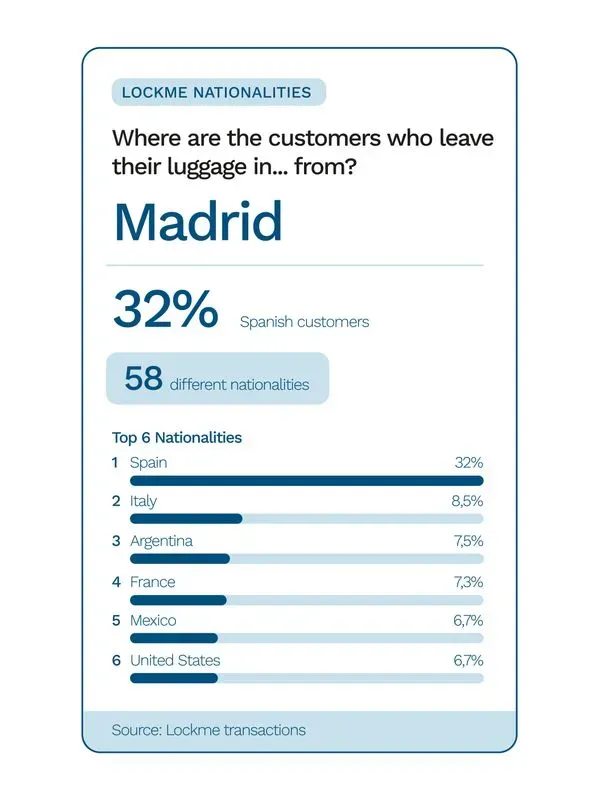
In Madrid, 32% of customers are Spanish — a surprisingly moderate share for the capital. The shop registers 58 different nationalities, and the top 6 shows a very distinctive pattern: alongside the usual Europeans, three Latin American and North American countries appear that together account for 20.9%.
- Spain — 32%
- Italy — 8.5%
- Argentina — 7.5%
- France — 7.3%
- Mexico — 6.7%
- United States — 6.7%
The reading is direct. Madrid still functions as the historical cultural gateway to Latin America: Argentina and Mexico beat the UK and Germany by volume. For an operator, this has very concrete implications — Spanish alone covers most of the international customer base, the weight of Spanish-speaking tourism justifies unusual demand peaks (transatlantic flights arrive very early in the morning), and marketing platforms aimed at Latin American audiences perform better here than in other Spanish cities.
Barcelona: the international epicentre
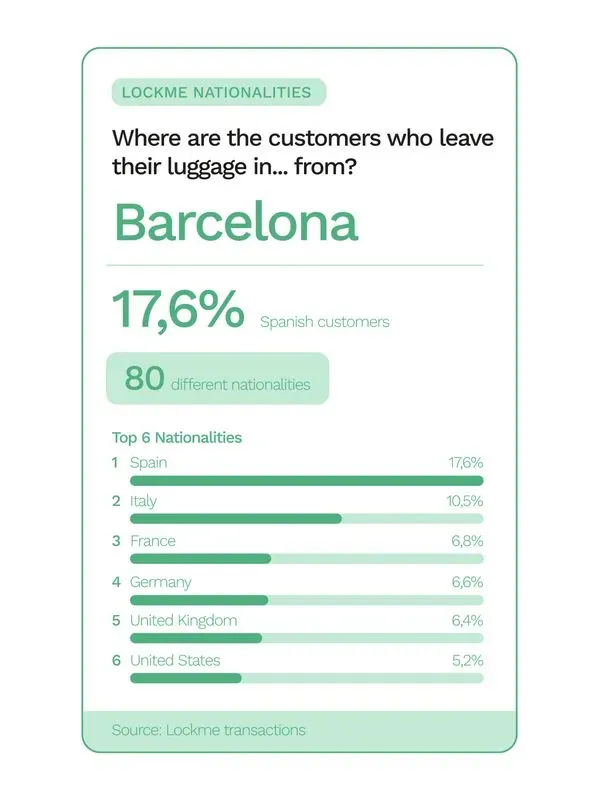
Barcelona is the mirror image. Only 17.6% of customers are Spanish — the lowest share of the three cities — and the shop registers 80 different nationalities, the widest diversity in the study.
- Spain — 17.6%
- Italy — 10.5%
- France — 6.8%
- Germany — 6.6%
- United Kingdom — 6.4%
- United States — 5.2%
The entire top 6 (except the US) is European, and the weight of domestic customers is less than half of Madrid's. The top five international markets together account for over 35% of total volume. An operator in Barcelona needs multilingual customer support, no exceptions — English at a minimum, ideally with Italian, French and German on the booking interface. Demand peaks follow the European vacation calendar (Easter, May bank holidays, August, Christmas), and the average stay tends to be shorter than in Madrid, with more weekend customers.
Barcelona isn't just touristic: it's a saturated destination with a nationality mix you won't find anywhere else in Spain.
Vigo: domestic tourism with a border effect
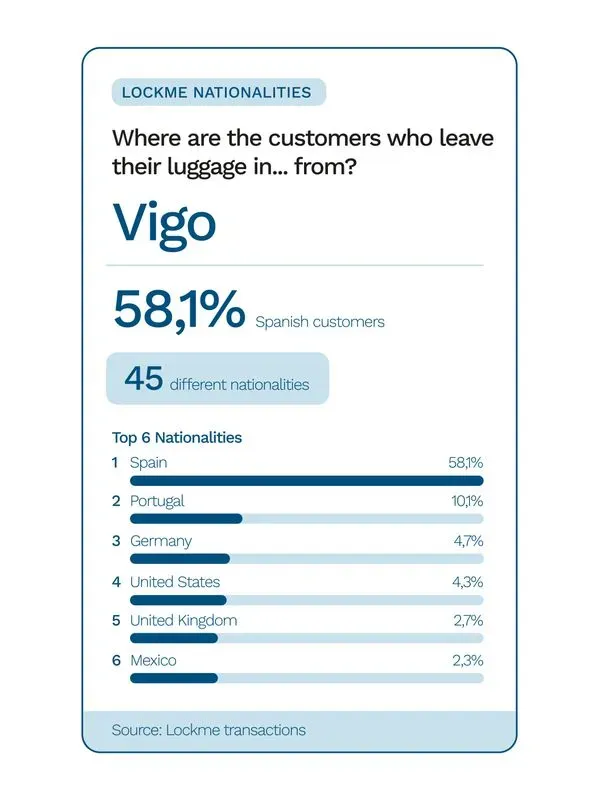
Vigo tells a different story. 58.1% of customers are Spanish — almost double Madrid and more than three times Barcelona — and the shop registers 45 nationalities, the lowest diversity of the three. But the most telling data point is who takes second place.
- Spain — 58.1%
- Portugal — 10.1%
- Germany — 4.7%
- United States — 4.3%
- United Kingdom — 2.7%
- Mexico — 2.3%
Portugal is the only non-Spanish nationality above 5%. Vigo sits less than 30 km from the Portuguese border, and the border effect is unmistakable: the city acts as a natural gateway for Portuguese tourism into Galicia, and as a logistical stop for Portuguese travellers crossing the peninsula. No other top-6 in the study includes Portugal — it doesn't appear in Madrid or Barcelona.
The rest of the ranking reveals a much more dispersed international customer, in low volumes. For an operator in Vigo, the business is overwhelmingly domestic and regional. Marketing in Spanish and Portuguese will outperform pan-European campaigns by a wide margin, and demand peaks follow Spanish public holidays and the Iberian vacation calendar.
Cross-city comparison: three cities, three different businesses
Side by side, the three cities show businesses that only share their surface:
| Metric | Madrid | Barcelona | Vigo |
|---|---|---|---|
| Spanish customers | 32% | 17.6% | 58.1% |
| Different nationalities | 58 | 80 | 45 |
| Number 2 | Italy (8.5%) | Italy (10.5%) | Portugal (10.1%) |
| Latin America in top 6 | Argentina, Mexico | — | Mexico |
| Visible border effect | — | — | Portugal |
Three radically different models:
- Madrid — cultural gateway to Latin America, balanced international mix, Spanish as the critical language (Argentina + Mexico shore up the share), demand skewed by transatlantic flight schedules.
- Barcelona — pure international epicentre, maximum diversity, mandatory coverage of 4-5 European languages, permanent customer support.
- Vigo — domestic tourism with a Portuguese border effect, regional marketing, Iberian holiday calendar.
What an operator should do with this data
The same luggage storage software (LockMe) serves all three cities — but the settings that pay off differ dramatically:
Languages and localisation. In Madrid, Spanish covers the majority of international customers (Spain + Argentina + Mexico ≈ 46%). In Barcelona, an operator offering only Spanish and English is actively neglecting 30% of their customers (Italians + French + Germans). In Vigo, Portuguese is as critical as English — more so if the shop sits near the station or the port.
Marketing and channels. Google Ads and social budget should mirror the customer origin profile. In Madrid, geo-targeted campaigns towards Argentina and Mexico can capture advance bookings. In Barcelona, European review platforms (TripAdvisor, Google in French, Italian and German) are the main source of organic traffic. In Vigo, Portugal deserves a dedicated campaign — it's half the international volume.
Staffing and kiosk hours. The time distribution of bookings varies by customer origin. Transatlantic flights from Latin America arrive in the small hours; European flights and trains arrive during the day. A Barcelona operator can tune the demand peak around 10-12h; a Madrid operator opens the critical window from 6h.
Payment methods. Each market has distinct payment preferences. American customers (US, Mexico, Argentina) expect Visa/Mastercard and Apple Pay. Germans expect Klarna, SEPA or even PayPal. French and Italian customers accept any European card without friction. LockMe integrates all of these — but how you communicate payment availability on the booking site should mirror the target market.
Receipts and invoicing. The language of the automated receipt matters more than it seems. In Barcelona, offering the receipt in the customer's language reduces complaints and improves Google Review ratings. In Vigo, a Portuguese receipt is a small detail an operator can toggle in LockMe that competitors rarely offer.
And your city?
Every city has its own profile. The data we've shared covers three LockMe shops in three very different cities — but the methodology applies to any operator. If you run a luggage storage shop on LockMe, you already have access to the same nationality dashboard in the management portal, and you can cross-reference your data with comparable operators to calibrate your business.
If you're thinking of opening a luggage storage shop and want to understand what customer profile to expect in your city, we can help you with comparable data from similar markets before you commit.
Request a demo — or check our plans.
Source: LockMe transactions in Madrid, Barcelona and Vigo, current year.